Ministry of Plenty
The Ministry of Plenty is one of the four Ministries between which the entire apparatus of government in Oceania is divided, and the one nominally responsible for economic affairs. Known in Newspeak as Miniplenty, it forms part of a system of deliberately inverted titles in which the Ministry of Peace wages war, the Ministry of Truth tells lies, the Ministry of Love maintains law and order, and the Ministry of Plenty presides over an economy of permanent shortage. Among the four Ministries it is the one whose ration announcements, quota statistics and rectified forecasts most constantly touch the everyday lives of the novel's characters; its manipulations of the chocolate ration and of the Lottery show how the Party manufactures and controls reality through the administration of scarcity.
Structure and Place in Oceania
The Ministry of Plenty was housed in one of four buildings in London of similar appearance and size, of which the most fully described, the Ministry of Truth, was an enormous pyramidal structure of glittering white concrete soaring three hundred metres into the air. So completely did the four dwarf the surrounding architecture that from the roof of Victory Mansions all of them could be seen simultaneously. Together these four Ministries divided the entire apparatus of government: the Ministry of Truth concerned itself with news, entertainment, education and the fine arts; the Ministry of Peace with war; the Ministry of Love with law and order; and the Ministry of Plenty with economic affairs. In Newspeak their names were compressed into Minitrue, Minipax, Miniluv and Miniplenty — clipped words of unmistakable meaning which could be uttered rapidly and which roused the minimum of echoes in the speaker's mind.
A Ministry of Negation
Emmanuel Goldstein's forbidden book, The Theory and Practice of Oligarchical Collectivism, singles out the names of the four Ministries as deliberate exercises in doublethink: 'The Ministry of Peace concerns itself with war, the Ministry of Truth with lies, the Ministry of Love with torture and the Ministry of Plenty with starvation.' The gap between name and function was demonstrated almost daily by the Ministry of Plenty's own announcements. While Winston waited in the lunch queue in the canteen, a telescreen announced that the standard of living had risen by no less than 20 per cent over the past year, that workers all over Oceania had marched out of factories in 'irrepressible spontaneous demonstrations' voicing their gratitude to Big Brother, and that there had even been demonstrations of thanks for the raising of the chocolate ration to twenty grammes a week. Only the day before, the same Ministry had announced that the ration was to be reduced to twenty grammes. 'Our new, happy life' was a favourite phrase of the Ministry of Plenty.
Winston knew from his own work in the Records Department that the chocolate ration was in fact to be cut from thirty grammes to twenty at the end of the present week, and he watched the canteen swallow the impossible announcement: Parsons swallowed it easily, the eyeless creature at the other table swallowed it fanatically, and even Syme swallowed it 'in some more complex way, involving doublethink'. Was he, then, alone in the possession of a memory?
The Fabrication of Statistics
The deceptions of the Ministry of Plenty were among the routine targets of the rectification work carried out in the Records Department of the Ministry of Truth. When the Ministry of Plenty had issued a 'categorical pledge' that there would be no reduction of the chocolate ration during 1984, the correction required of Winston was to substitute for the original promise a warning that it would probably be necessary to reduce the ration at some time in April. The scale of the falsification was staggering. The Ministry of Plenty's official forecast had estimated the output of boots for the quarter at a hundred and forty-five million pairs; the 'actual output' was given as sixty-two millions; Winston, rewriting the forecast for the record, marked the figure down to fifty-seven millions so as to allow for the usual claim that the quota had been over-fulfilled. 'Very likely no boots had been produced at all,' he reflected; perhaps half the population of Oceania went barefoot while astronomical numbers of boots were produced on paper. To Winston such jobs were almost routine: three messages slid out of the pneumatic tube while he was working, 'but they were simple matters, and he had disposed of them before the Two Minutes Hate interrupted him.'
The pattern of false abundance reached even into the future. In the novel's final section, Winston, sitting in the Chestnut Tree Café, hears a telescreen announcement that in the preceding quarter the Tenth Three-Year Plan's quota for bootlaces had been overfulfilled by ninety-eight per cent. The Ministry of Plenty's statistics had become a closed system of self-congratulation, in which every quota is always overfulfilled and every shortage is always presented as a victory.
The Lottery and the Proles
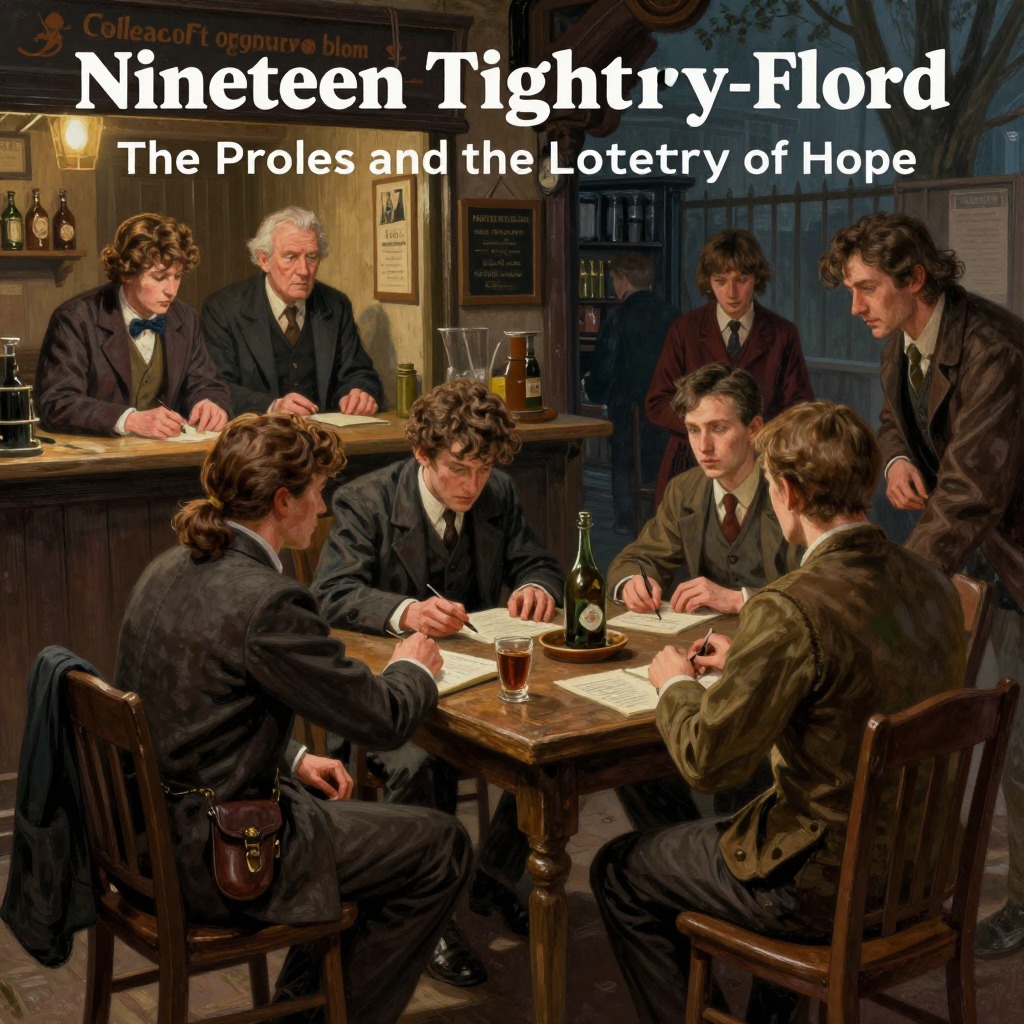
Within the submerged economy of the proles, the Ministry of Plenty's most important instrument was the Lottery. It was 'the one public event to which the proles paid serious attention', and for some millions of them it was probably the principal if not the only reason for remaining alive — their delight, their folly, their anodyne, their intellectual stimulant. Around it there grew up a whole tribe of men who made a living by selling systems, forecasts and lucky amulets. Winston had nothing to do with its running, but he was aware that the prizes were largely imaginary: only small sums were actually paid out, the winners of the big prizes being non-existent persons, which was not difficult to arrange in the absence of any real intercommunication between one part of Oceania and another. The Lottery was the Ministry of Plenty's lower-level counterpart to the general operation by which the Ministries supplied the Party with a manufactured reality — the same operation that the Ministry of Truth repeated at a cheaper, cruder level for the benefit of the proles.
The Measure of a Regime
The Ministry of Plenty also dictated the physical texture of life. The 'economy drive in preparation for Hate Week' that cut off the electric current during daylight hours and left the lifts at Victory Mansions out of order belonged to its domain, and Winston's whole experience of scarcity — the gritty soap, the cigarettes that came to pieces, the food with its strange evil tastes — was the ministry's work made visible. Yet to Parsons the same institution could still be an object of simple admiration: 'The Ministry of Plenty's certainly done a good job this year,' he declared in the canteen after the latest announcement of abundance. The discrepancy between Parsons's credulity and Winston's knowledge is the novel's recurring lesson: the Ministry of Plenty is judged not by the reality of hunger but by the plausibility of its lies. It is the purest institutional embodiment of the Party's economics, in which, as O'Brien tells Winston in the Ministry of Love, 'the object of power is power' — and in which plenty is simply the administratively produced name for its opposite.